Read in Other Languages
For most of 2024 the story about artificial intelligence was a story about model capability. In 2026 it has quietly turned into a story about balance sheets, debt issuance and the power grid. The numbers below are not forecasts — they are the public state of the system as reported by GMO and Stack Overflow this quarter.
Capex at a scale the cycle has not seen
Four companies — Amazon, Alphabet, Meta and Microsoft — are now spending roughly $300 billion a year on capital expenditure, the bulk of it on AI infrastructure. To put a number on what funds it: annual debt issuance tied to AI and data-centre buildout has gone from $166B in 2023 to $625B in 2025. That is nearly a fourfold increase in two years.
The financing picture, company by company
- Meta — shifted from a net cash position of nearly +$30B in 2023 to roughly −$7B today. The Hyperion data-centre project ($30B) is financed off-balance-sheet through a special-purpose vehicle managed by Blue Owl Capital.
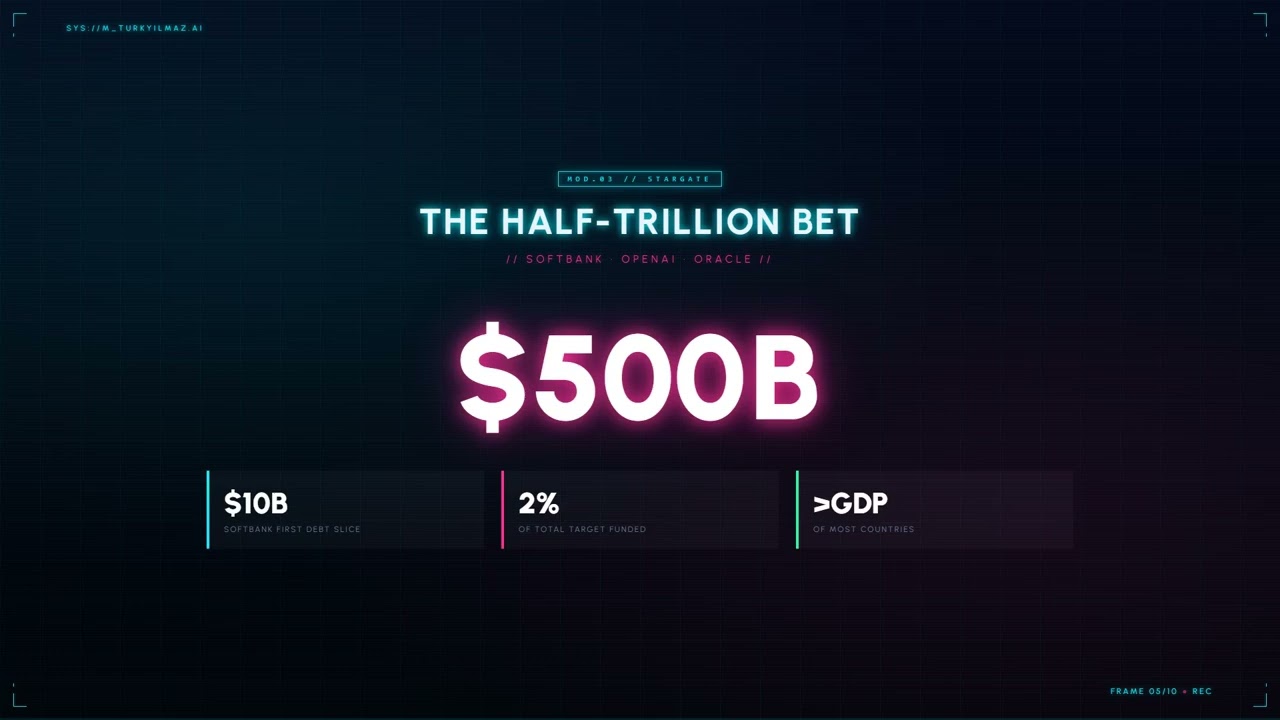
- SoftBank / Stargate — first $10B of borrowing drawn against a stated target of $500B.
- Oracle — carries more than $100B in net debt; burned $12B in cash in Q3 2025 alone. Credit default swap spreads widened from 40 bps to 140 bps between September and December. The stock fell about 40% over that window.
- Blue Owl Capital — down roughly 20% since summer, reflecting its exposure to these SPV structures.
Source: GMO Research, "Valuing AI: Extreme Bubble, New Golden Era, or Both" (2026).
Why this differs from the dot-com analogue
The reflex comparison is to 1999. The capital intensity is similar but the leverage profile is not. In 1999 the bubble was largely equity-funded by retail and venture money. In 2026 the same buildout is being financed through high-grade corporate debt, off-balance-sheet SPVs, and private credit funds with concentrated exposure to a small handful of borrowers. The Oracle CDS move from 40 to 140 basis points is the credit market beginning to price that concentration.
If the same capex were funded through equity, the system would punish hyperscaler shareholders. Funded through debt and SPVs, it punishes credit — and credit transmits faster.
The macro tell: electricity
Data centres run on electricity, and electricity is one of the few inputs that shows up directly in consumer prices. According to the same GMO compilation, US electricity prices have risen roughly 39% over the past five years. DRAM prices, the other bottleneck input, climbed 172% year-over-year in Q3 2025.
This is the difference between an "abstract" bubble and a tangible one: the cost of the bubble is showing up on household utility bills.
The developer side: adoption is real
The demand side of the story is harder to dismiss. The Stack Overflow 2025 Developer Survey reports that 84% of developers are using or planning to use AI tools, up from 76% the prior year. Daily usage runs at 47.1% across all respondents and 50.6% among professional developers. Weekly: 17.7% and 17.4% respectively.
What the Stack Overflow numbers do and do not tell us
The survey confirms that AI tooling has crossed from novelty into routine workflow for roughly half the professional developer base. What it does not confirm is the next link in the investment thesis: whether AI workflow produces enough enterprise productivity to amortise $300B/year of capex and $625B/year of debt issuance. Two different debates: adoption is settled, monetisation is not.
Source: Stack Overflow 2025 Developer Survey (survey.stackoverflow.co/2025/ai).
Synthesis
Three threads, one picture. Capex is real and historically large. Financing has shifted from equity to credit, concentrating risk in CDS spreads and private-credit SPVs rather than retail equity. Macro spillover is no longer hypothetical — electricity at +39% over five years is the receipt. Adoption on the developer side is settled at 84%. The unresolved question is whether enterprise monetisation closes the gap before the credit market reprices the debt.
This is what the Wednesday AI column will be tracking through 2026: not whether the models get better, but whether the cash flows arrive before the bond covenants do.
— GMO Research, Valuing AI: Extreme Bubble, New Golden Era, or Both (gmo.com, 2026).
— Stack Overflow 2025 Developer Survey, AI section (survey.stackoverflow.co/2025/ai).
Two further sections of the working report — the US $2B quantum equity programme and Canada's CQCP Phase 1 — could not be independently verified for this publication and have been held back.